


Katerina Tsitsela: Between Light and Emotion
Katerina Tsitsela: Between Light and Emotion The Language of Color: Translating Emotion into Visual Dialogue Katerina Tsitsela stands as a compelling voice in contemporary art, using color as her principal tool for interpreting identity and emotional complexity. Her work explores the connection between what is seen and what is felt, bridging the visible surface with internal experiences. Emotion drives every aspect of her creative process, from palette choices to brushstroke movement, resulting in artwork that speaks to both personal and collective narratives. Her approach is not merely aesthetic; it is emotional architecture shaped by lived experience. Tsitsela invites viewers to experience art not only through sight but also through their own emotional filters, forging a quiet intimacy between the artwork and the audience. Growing up with a deep sensitivity to how color could mirror mood, Tsitsela developed an instinctual approach to expression. From early on, painting became a space where she could translate complex inner states into abstract visual languages. Her formal education at the Accademia di Belli Arti Pietro Vanucci in Perugia and Aristotle University of Thessaloniki honed her technical skill, but it was her introspective nature that ultimately shaped her artistic identity. She developed a process that is both spontaneous and rigorous, relying heavily on intuition while exploring psychological themes. Through each piece, she seeks to evoke reflection, encouraging the viewer to confront their own emotional histories. Her commitment to this emotional connection is perhaps best exemplified in her deeply personal work titled Pain. Created during a difficult period in her life, this oil-on-paper piece uses intense, saturated hues to explore vulnerability and inner strength. The materiality of the oil paint adds a tactile dimension, mirroring the rawness of the emotion itself. For Tsitsela, this painting marked a transformative point in her artistic journey, solidifying her belief in the healing potential of art. It became more than just a painting; it was a dialogue with herself, an affirmation that honesty in artistic expression has the power to connect, comfort, and transcend. Katerina Tsitsela: Internal Landscapes as Emotional Geography At the heart of Tsitsela’s practice lies a fascination with the intersection of psychological and physical environments. Her concept of “internal landscapes” emerges from a desire to visually render the abstract emotional terrain we all navigate. These landscapes are not depictions of external nature but manifestations of the soul, shaped by memory, introspection, and the emotional residue of lived experience. Rather than traditional representation, her paintings serve as psychological cartographies, mapping out sorrow, desire, anxiety, and transformation through texture and tone. Her works do not merely illustrate feelings — they embody them, embedding them in layers of pigment and material. Her visual language is rich with symbols of rupture and repair. By incorporating materials such as cement mortars, engraving, and collage into her paintings, she explores how tactile elements can mirror the human psyche. This physicality becomes especially significant in portraying emotional states linked to isolation and trauma, particularly during and after lockdown periods. The textures she creates suggest both erosion and endurance, forming surfaces that seem to carry the weight of internal struggle. These choices are not accidental but deliberate acts of expression, each mark on the canvas acting as a scar or memory etched into emotional skin. This emphasis on material is also central to how Tsitsela expresses mnemonic experiences. The fusion of gesture and material becomes a way of capturing the ephemeral — fleeting memories, passing moods, and transient moments of revelation. Her engagement with earthy tones and aggressive textures speaks to a raw, unfiltered truth that resists aesthetic prettiness in favor of visceral honesty. This is not art made for passive admiration but for active emotional participation. Through this approach, Tsitsela presents a body of work that is unflinching in its search for emotional authenticity, inviting the viewer to inhabit these internal terrains with her. Emotional Tension in Color and Texture The visual tension in Tsitsela’s paintings comes not from conflict between figures or narrative, but from the layered interaction of materials and color. She uses bold hues and dramatic contrasts to build emotional resonance, making the canvas a stage for the push and pull between inner turmoil and external calm. Her paintings are filled with movement — not the movement of depicted subjects, but the movement of feeling as it shifts, accumulates, and occasionally explodes across the surface. In her hands, color is never static; it vibrates, lingers, and at times confronts, forcing the viewer to navigate their own reactions in real time. In moments where cement dust and color merge, Tsitsela achieves a balance between weight and translucency, roughness and fluidity. This fusion of substance and shade creates visual experiences that feel both grounded and intangible. The physical density of her materials, when combined with the emotional charge of her color palette, invites an embodied response. Viewers are not simply seeing a painting — they are feeling its weight, its texture, and its emotional residue. Her emphasis on abstract form and sensory materiality shifts the experience of art away from the intellectual and into the visceral, anchoring her practice in the body as much as the mind. Tsitsela’s attention to the struggle of human emotion in contemporary life is particularly resonant in the aftermath of the global lockdown. Her artworks reflect on solitude, emotional fatigue, and the search for meaning in disrupted routines. Yet, rather than portray despair alone, she threads light through her compositions — both literally and metaphorically. These luminous elements act as signs of resilience and continuity, piercing through the emotional fog. They serve as reminders that even within moments of isolation and uncertainty, there remains the possibility of connection, reflection, and inner growth. Her work captures not only what it means to feel deeply but also what it means to continue feeling amid profound change. Katerina Tsitsela: The Art of Excessive Truth What drives Tsitsela’s exploration is a commitment to what she describes as the “excessive truth” that lies beneath surface appearances. This truth is not about factual accuracy but
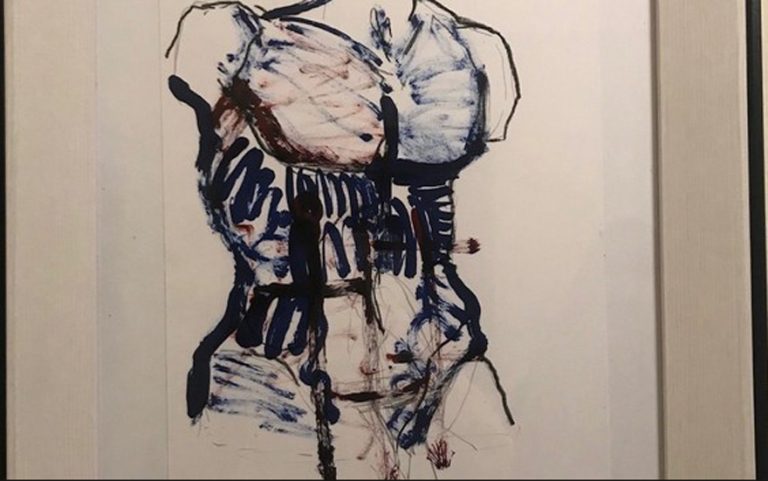
The Naked Truth
The Naked Truth The curator of the exhibition Mrs. Latousaki notes: “When is a man naked? Does naked only concern clothes, clothing and naked body? Real nakedness and honesty can also exist inside a dressed body with a look that is not hidden. A naked person can be characterized as one whose nothing is burdened by thought, consciousness and soul. The one who has nothing to fear or the one who has lived a lot. And undoubtedly, how every artist can and understands nudity, truth and human honesty, has a great social and artistic interest. “ Curator: OLGA LATOUSAKI Artists:Maria Vamvakidis, Natassa Vlachaki, Eleni Griva, Michalis Eleftheriou, Gerasimos Thomas, Aris Kaiafas, Giorgos Kastanakis, Giannis Kornilios, Charalambos Kristallogiannis, Evangelos Liougas, Konstantia Makri, Sofia-Elena Mahaira, Oleas Mousasghetis, Melina Moisideli, Haris Pamfilis, Suzana Papakalati, Evdoxia Papasavva, Dimitris Ribas, Christina Sgouridis, Athena Jane, Georgia Troulis, Fai Tsakalidou, Eleni Tsaldiris, Katerina Tsitsella, Kyriakos Fragozidis, Phaedra Kharda.
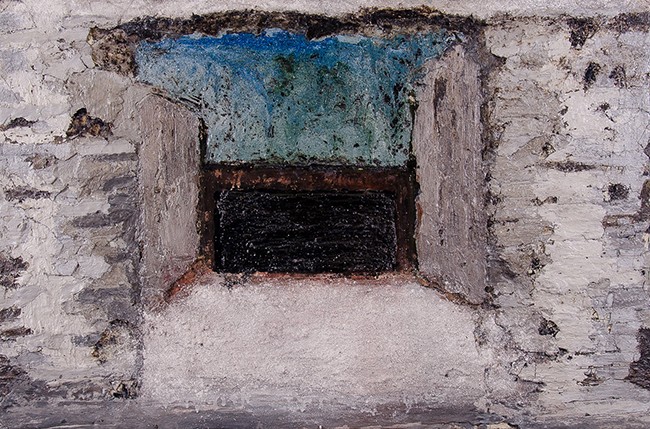
Exploring the Depths of Human Psyche through Art: The World of Katerina Tsitsela
Exploring the Depths of Human Psyche through Art: The World of Katerina Tsitsela Katerina Tsitsela‘s artistic journey spans from the strokes of a paintbrush to the delicate engravings on canvas, all in pursuit of unraveling the mysteries of human perception and emotion. “I am an artist whose artistic research ranges from painting to engraving,” Tsitsela explains. “My work delves into human perception of landscapes expressing specific mental situations. They are interpreted psychoanalytically as ‘internal landscapes’ or landscapes of the human soul.” Tsitsela’s creations serve as windows into the depths of the human psyche, portraying internal struggles and emotional landscapes with striking clarity. Through her use of color and texture, she brings to life the turmoil and complexity of the human experience, inviting viewers to confront their own inner landscapes. “Through my work, I show the emotional and mental condition,” Tsitsela reflects. “Human anxiety and depression are also apparent in my work, and at the same time, the struggle of humans to cope with these difficult situations in an authentic way.” In her latest series, Tsitsela explores the profound impact of the global lockdown on the human psyche. As the world grapples with solitude, uncertainty, and the challenges of self-reflection, Tsitsela’s art serves as a poignant reflection of the collective emotional landscape. “Lockdown has forced people to think deeper about the conditions of their lives,” Tsitsela observes. “They loved in a way solitude and tranquility, but on the other hand, problems of self-knowledge have made their appearance. In addition, it is not easy to surpass the difficulties.” Through her bold strokes and evocative imagery, Tsitsela captures the essence of this tumultuous period, illuminating the inner struggles and resilience of the human spirit. Each canvas is a testament to the power of art to transcend boundaries and connect us to our shared humanity. “My interest focuses on the search of excessive truth which lies beyond our journey to material,” Tsitsela asserts. “The color, along with the turmoil caused by the tactile touch of the cement on the surface of the canvas, witnesses the emotional state in which both the figures and landscapes are.” In Tsitsela’s world, art is more than just a visual experience—it is a journey of self-discovery and introspection. Through her intricate compositions and powerful symbolism, she invites viewers to embark on a voyage into the depths of their own souls, where truth and beauty converge in a timeless dance. As we navigate the complexities of the human experience, Tsitsela’s art serves as a guiding light, reminding us of the resilience of the human spirit and the transformative power of creativity. In a world filled with uncertainty and turmoil, her work offers a glimpse of hope and healing, inspiring us to embrace the beauty of our own inner landscapes.
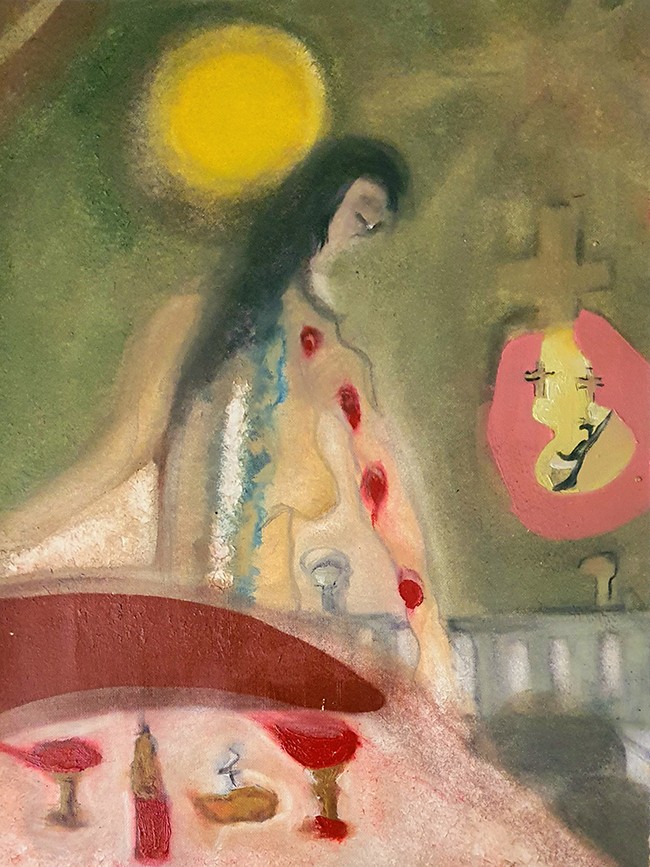
KATERINA TSITSELA: EXPLORING THE INNER LANDSCAPES OF THE HUMAN SOUL
KATERINA TSITSELA: EXPLORING THE INNER LANDSCAPES OF THE HUMAN SOUL Katerina Tsitsela, an artist hailing from Thessaloniki, Greece, embarks on a journey of artistic exploration that spans continents and mediums. Her work, which encompasses everything from painting to engraving, delves deeply into the intricacies of human perception, expressing the complexities of the mind through what she aptly describes as ‘internal landscapes’ or landscapes of the human soul. Born in Thessaloniki, Katerina’s artistic journey began with her formal education in painting at the Accademia di Belle Arti, Pietro Vanucci, in Perugia, Italy, from 2000 to 2003. This was just the first step on her path to becoming an artist. Subsequently, she continued her education at the Fine Arts of the Aristotle University of Thessaloniki, Greece, from 2006 to 2014. Her dedication to her career further led her to attain a Master of Fine and Applied Arts degree from the Department of the School of Fine Arts at Aristotle University. What sets Katerina Tsitsela apart from other artists is her ability to translate the intangible facets of the human experience into visual art. Her work is an exploration of the inner workings of the human mind, and her paintings are a testament to her keen insight into the human psyche. Katerina’s art is a mesmerizing journey through internal landscapes that reflect various mental states and emotions. It’s a psychoanalytical exploration of the human soul, presented on canvas. The darkness and depth of these ‘internal landscapes’ are illuminated by beams of light, offering a sense of hope and understanding. As you gaze upon her work, you can’t help but feel like a silent observer of these intricate and intimate moments of human existence. What is particularly striking about Katerina’s work is her pursuit of an ‘excessive truth’ that lies beyond the tangible and material world. She reaches deep into the reservoir of human emotions and thoughts, bringing forth a unique perspective that challenges the viewer to contemplate their own inner landscapes. Her art serves as a portal into a realm of emotions, dreams, and thoughts that are often hidden from the surface. Katerina’s choice of colors and the texture created by the tactile touch of cement on canvas add layers of complexity to her work. The earthy tones she employs evoke a sense of grounding and connection to the natural world. The bold, expressive strokes that form her figures and landscapes provide an immediate emotional impact. The canvas becomes a canvas of human experience, where every brushstroke reflects the emotional state of the subject, be it a figure or a landscape. One can’t help but be drawn into Katerina’s world, which is defined by her unique and evocative style. Her work is a fusion of raw and imposing touches, capturing the essence of the surroundings, whether they are internal or abstract. These elements are interwoven into a tapestry of human existence, with each piece telling a story that invites the viewer to explore their own emotions and experiences. Katerina’s most recent research delves into the use of natural materials on a larger scale. This exploration further highlights her deep-rooted interest in the process of creating art and the interaction of these materials with the artistic process. Her work serves as a relic of working, gesture, and movement, capturing not just the final product but the essence of the artistic journey itself. In a world where art often serves as a mirror to the external, Katerina Tsitsela’s work stands as a unique and captivating testament to the internal landscapes that define us. Her art challenges us to look beyond the surface, to explore the depths of the human soul and the complex interplay of emotions and thoughts that shape our existence. Katerina’s work is not just a visual experience; it’s a journey into the depths of human consciousness. Her ability to capture the intangible aspects of the human experience and translate them into art is a testament to her skill and dedication as an artist. Her work invites us to reflect on our own ‘internal landscapes’ and to connect with the emotions and experiences that make us human. In a world that often prioritizes the external, Katerina Tsitsela reminds us of the importance of introspection and the beauty of the inner landscapes that define our humanity. Her art is not just a representation of the world; it’s an invitation to explore the world within.